Craft
Gemstone settings: prong, pavé, channel and bezel compared
The setting decides how bright a stone looks, how safe it is and how much care it needs. Eight common settings compared, and how to recognize fine setting work.
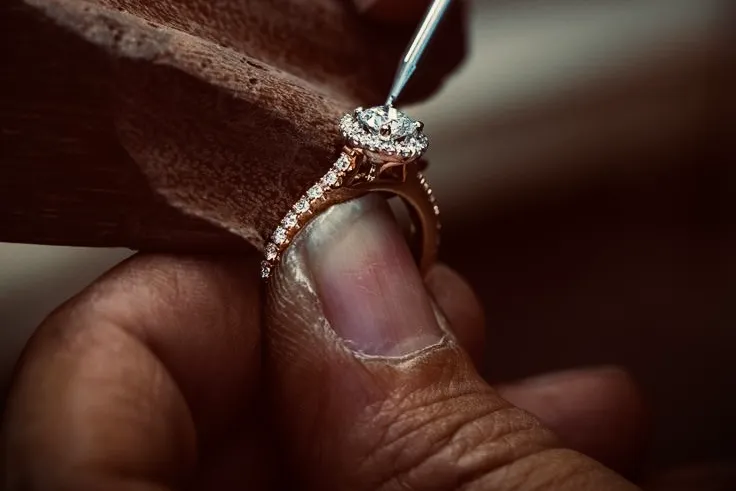
Put the same gemstone in two different settings and you get two different results: brighter or more discreet, safer or more likely to catch, low-maintenance or in need of regular checks. The setting is the least asked-about part of choosing jewelry, yet it decides how a piece looks after five years of wear.
A setting does three jobs
Every setting has to do three things at once:
- Hold the stone in place through everyday knocks.
- Let light in and back out again.
- Protect the girdle and any pointed corners, where a stone chips most easily.
These three always trade off against each other. The more metal around the stone, the safer it is and the less light it gets. The less metal, the brighter the stone and the more it depends on a few small contact points. Understand that trade-off and you understand most of what there is to know about settings.
Prong setting
Metal “claws” rise from the mount and grip the stone’s girdle. This is the most common setting for a center stone.
- Four prongs: show the most stone and make a round look slightly squarer. If one prong fails, the stone can fall out.
- Six prongs: safer — lose one and the stone is still held — and make a round look rounder. They cover a little more of the stone.
- Prong tips: rounded tips are soft and catch less; claw tips are finer and look more modern; V-prongs wrap the points of pear, marquise or princess cuts to protect them.
Strengths: light enters from the most directions, the underside of the stone is easy to clean, and the stone looks its full size.
Keep in mind: prongs wear down over the years and can catch on fabric. This is the setting that most needs periodic checks.
Bezel setting
A rim of metal surrounds the whole perimeter of the stone. The half-bezel variant grips two sides and leaves the ends open.
Strengths: the best protection of any setting — the girdle is fully covered, there is nothing to catch, and the lines are clean and modern. Ideal for people who work with their hands.
Keep in mind: less light gets in, so the stone is less fiery than in prongs, and it looks slightly smaller because the rim covers its edge.
Pavé and micro-pavé
“Pavé” means paved. Many small stones are set close together across a surface, each held by tiny beads raised from the gold itself; neighboring stones usually share beads. When the stones are very small and the beads are almost invisible to the eye, it is called micro-pavé.
Stones can be laid in straight rows or staggered in a honeycomb pattern to cover a surface with the fewest gaps — the arrangement familiar from iced-out jewelry.
Strengths: one continuous bright surface with almost no visible metal.
Keep in mind: hundreds of stones mean hundreds of contact points. Each bead is tiny and withstands knocks less well than a large prong. Resizing a fully paved ring is also difficult, because bending the band distorts the seats.
Channel setting
Stones sit side by side in a groove between two walls of metal; there are no prongs between them, and the walls hold their girdles from both sides.
Strengths: a smooth surface with nothing to catch, and protected girdles. It suits square and baguette cuts and rings worn every day.
Keep in mind: light enters only from above, and dirt collects in the channel. If a wall is dented by a hard knock, the whole row can loosen.
Bar setting
Similar to channel, but each stone is held by two slim bars on either side, with its ends left open. It lets in more light than a channel and creates a clear rhythm of metal and stone. The open ends are also the less protected part.
Flush setting
The stone is lowered into a hole drilled in the gold, its table level with the metal surface; the surrounding gold is burnished over the girdle to hold it.
Strengths: almost impossible to catch or pull out — the most durable setting for daily wear, common on men’s wedding bands.
Keep in mind: the stone receives the least light and sparkles only gently; it needs a band thick enough to take it.
Invisible setting
Square-cut stones are grooved below the girdle and slid onto a hidden rail framework, fitting so closely that no metal shows between them. The effect is an unbroken plane of stone. In return, it demands great skill and is the hardest setting to repair when a stone loosens or chips.
Halo and hidden halo
A halo is an arrangement more than a technique of its own: a ring of small pavé stones around the center stone, making it look larger and brighter. A hidden halo places that ring below the center stone’s girdle, visible only from the side.
Because it is pavé, a halo brings both the advantages and the care requirements of pavé.
At a glance
- Most sparkle: prong, pavé.
- Best protection for the stone: bezel, flush.
- Least likely to catch: flush, bezel, channel.
- Easiest to clean: prong.
- Needs checking most often: pavé, micro-pavé, high prong settings.
- Hardest to repair and resize: invisible, full pavé.
Setting and karat
The smaller the prong, the more the hardness of the alloy matters. On a design fully covered in stones, a harder alloy keeps beads from wearing down or bending; for a large center stone on thick prongs, 18K holds perfectly well. The comparison is in 10K, 14K or 18K: how to choose your gold karat.
What to look for in an iced-out piece
On a fully paved piece, setting quality shows in evenness:
- Stones of the same size, in straight lines, with tables on one plane. Tilted under a lamp, the surface reflects like a single sheet instead of flickering at random.
- Beads that are round, even and smooth, with no sharp edges.
- Small, even gaps between stones; no odd patches of bare gold.
- Nothing catches. Draw a piece of fine fabric lightly over the surface: if it snags, a prong has lifted.
- A tidy back. Evenly cut openings behind the stones are a sign of careful work.
Signs of a loose stone
- A rattle when you shake the piece gently near your ear.
- A stone that sits tilted or lower than those around it.
- Prongs that catch on hair or fabric.
- A visible gap between a prong and the girdle.
If you notice any of these, stop wearing the piece and have it checked. Daily care is covered in Caring for gold jewelry set with gemstones.
Four questions to ask about a setting
- How many prongs hold the center stone, and what kind of tips do they have?
- Can this design be resized, and within what limits?
- How often should the prongs be checked?
- If a small stone falls out, how is resetting supported?
At T Gold
From the 3D drawing to the finished piece, crafting and stone setting are carried out and supervised directly at the T Gold workshop. When advising, a specialist recommends the setting according to the form of the piece, the gemstone and the way you wear it; support for resetting gemstones is part of the policy on the Warranty & care page.