Buying guides
Promise ring, engagement ring, wedding band: the differences and which hand
Three rings, three moments: what each means and how it is designed, whether you need all three, which hand and finger, wearing two together, and the “months of salary” rule.
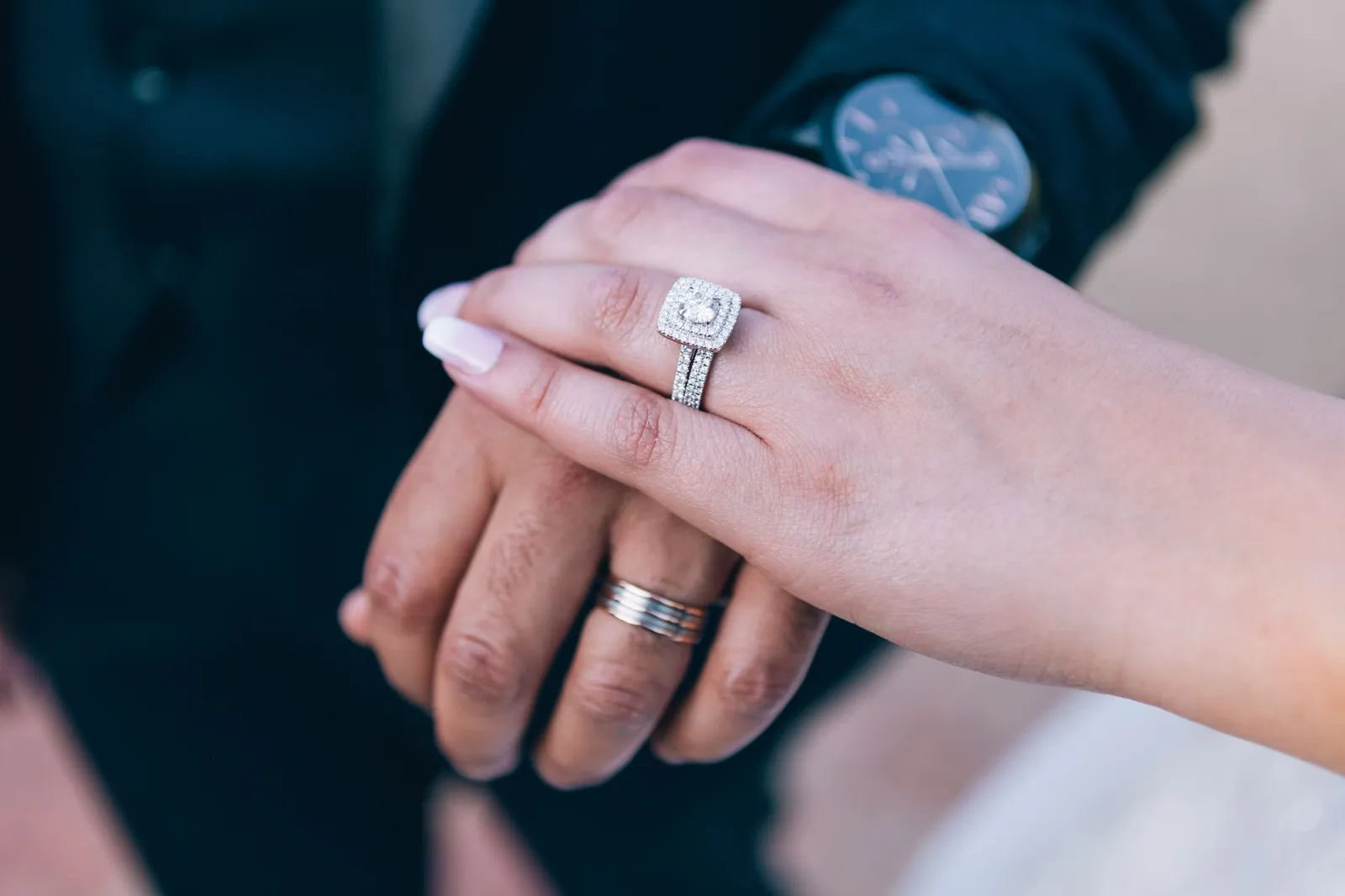
These three rings are often called by each other’s names, and many people only notice the difference once they are standing at the counter. Each belongs to a different moment in a relationship, follows a different design logic and is worn in its own way. Knowing each one helps you choose the right piece at the right time — and avoid buying more than you need.
Three rings, three moments
The promise ring
Also sold as couple rings. This is the ring of the dating years: a commitment between two people, tied to no ceremony and not yet a proposal.
- When: any time — a first anniversary, a birthday, before a long trip apart.
- Who wears it: usually both, as a pair.
- Design: simple and slim, often a plain band or one with a small gemstone accent, engraved with a name or date.
- Where: there is no convention. Many choose the middle finger or the right ring finger, keeping the left ring finger for later.
The engagement ring
The ring given with the most important question, worn from the “yes” to the wedding day — and on afterwards.
- When: at the proposal. In Vietnam, some families present it at the betrothal ceremony.
- Who wears it: traditionally the person proposed to.
- Design: a prominent center stone — the clearest difference from the other two.
- Where: the ring finger.
The wedding band
The ring exchanged at the wedding and worn every day from then on.
- When: during the wedding ceremony.
- Who wears it: both, as a pair.
- Design: comfort and durability first — a plain band, or stones set flush or in a channel.
- Where: the ring finger.
At a glance
Meaning
- Promise ring: “we are serious about each other”.
- Engagement ring: “we are going to marry”.
- Wedding band: “we are married”.
Design
- Promise ring: the lightest, with the smallest budget.
- Engagement ring: the most striking, built around its center stone.
- Wedding band: the most durable, made to be worn for decades.
Quantity
- Promise ring: a pair.
- Engagement ring: one.
- Wedding band: a pair.
Do you need all three?
No. Each is a separate choice:
- Wedding bands are the ones almost every couple has, because they belong to the ceremony.
- Engagement rings are increasingly common in Vietnam, but not required.
- Promise rings are entirely up to the two of you.
One ring can also play two roles: many couples choose an engagement ring sturdy enough to continue as the bride’s wedding ring, or turn their promise rings into wedding bands by engraving the wedding date.
Which hand, which finger?
Why the ring finger?
The ancient Romans believed a vein ran straight from the fourth finger of the left hand to the heart — the “vein of love”. Anatomy does not support it, but the custom stayed.
There is a more practical reason: for right-handed people the left hand takes fewer knocks, and the ring finger does the least work — a ring and its stone are safer there.
Left or right?
- Most Western countries: the left hand.
- Germany, Russia, India and much of Eastern Europe: the right hand.
- Vietnam: most commonly today, the left ring finger for both partners. The older saying “nam tả, nữ hữu” — men on the left, women on the right — is still followed in some families.
There is no binding rule. The only thing worth agreeing on is that the two of you wear them the same way, or both know why you do not.
When you have both an engagement ring and a wedding band
Three common approaches:
- Both on one finger: the wedding band on the inside, nearer the base of the finger; the engagement ring outside it. On the wedding day the bride usually moves the engagement ring to her right hand for the exchange of bands, then puts it back.
- One on each hand: wedding band on the left, engagement ring on the right.
- Wedding band only for every day, with the engagement ring kept for special occasions — a practical choice for people who work with their hands.
Making the rings work together
If the engagement ring and wedding band will sit side by side, think about both from the first one.
- The same gold color and karat, so they read as a set and wear evenly where they rub.
- An engagement setting high enough for the band to slide in under it. With a low setting or a large halo, choose a curved band that follows the center stone.
- Similar thickness, so the two sit level.
Two guides go deeper into each: Choosing an engagement ring: center stone shapes and settings and Choosing wedding bands as a pair.
Budget, and the “months of salary” rule
The advice that an engagement ring should cost two months’ salary is not a tradition. It comes from the advertising of the diamond company De Beers: first one month’s salary, then two by the 1980s. The same company’s campaign, with the line “A Diamond Is Forever” written in 1947, is what made the diamond ring the default image of a proposal.
Knowing where it comes from takes the pressure off: there is no “correct” figure. Some realistic ways to divide a budget:
- Put it into the center stone: choose Moissanite or Lab Diamond for more size at the same spend.
- Put it into the wedding bands: they are the rings worn every day, for the longest.
- Split it evenly, and choose an engagement design that can be worn for life.
The gemstones are compared in Moissanite, Lab Diamond or natural diamond?
Frequently asked questions
Are couple rings wedding rings?
Not necessarily. “Couple rings” are simply two rings made as a pair; they become wedding rings when exchanged at the ceremony.
Do men wear engagement rings?
Traditionally no, but more and more couples choose to both wear one. It is a personal choice.
Can the engagement ring also be the wedding ring?
Yes. In that case choose a low setting, secure prongs and a band thick enough for daily wear.
How do I propose without knowing the ring size?
See the discreet methods in How to measure ring, chain and bracelet size at home, and choose a design that can be resized.
How far ahead should wedding bands be ordered?
Earlier than you think, especially for made-to-order rings: they need time for crafting, fitting and resizing. Ask for the specific timeline for your design at the first consultation.
At T Gold
T Gold crafts both engagement rings and wedding bands in 10K, 14K and 18K gold with Moissanite, Lab Diamond and natural diamond. On the Custom page, two 3D design tools (currently in Vietnamese) let you build an engagement ring and a pair of wedding bands and study every detail before sending the design. Once you have a direction, book a consultation to try them on.