Buying guides
How to measure ring, chain and bracelet size at home
Measuring properly takes less than ten minutes: two ways to find your ring size, a circumference-to-diameter chart, where each chain length sits and how to measure the wrist.
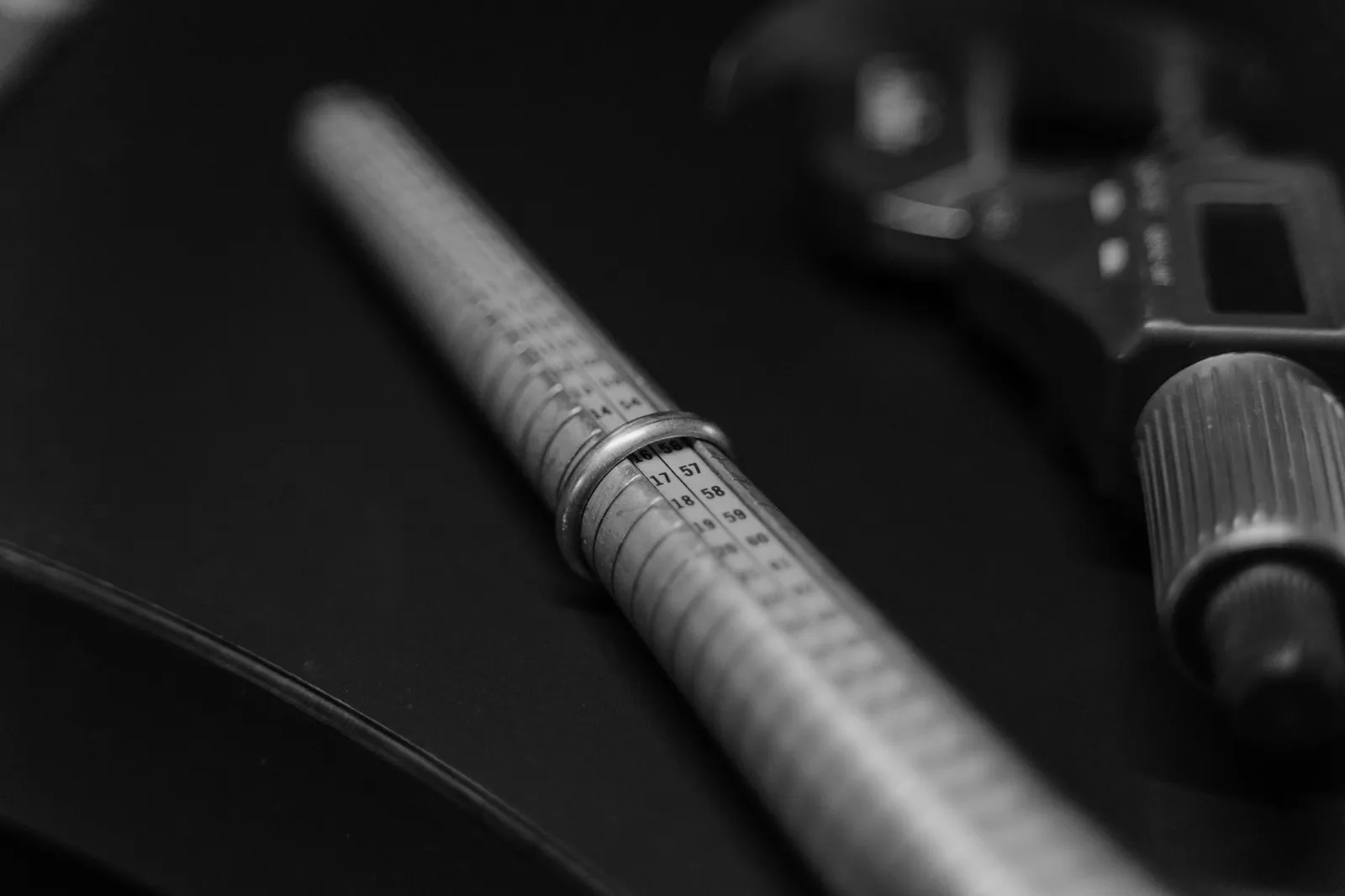
However beautiful a piece is, it loses much of its worth if it does not fit: a loose ring spins and slips off, a tight one is uncomfortable all day, and a chain of the wrong length puts the pendant in the wrong place. Measuring properly takes less than ten minutes and needs only things you already have at home.
Four things to know before you measure
- Measure at the end of the day, with warm hands. Fingers are smallest in the morning and in the cold, largest in the late afternoon and evening. Avoid measuring right after exercise, a hot shower, alcohol or salty food.
- Measure the right finger on the right hand. The dominant hand is usually about half a size larger. The left and right ring fingers are not the same.
- Measure three times at different times of day and take the figure that repeats.
- Write it down in millimeters. It is the one unit that cannot be misread, whatever sizing system the workshop uses.
Measuring ring size
Method 1: measure a ring that already fits
This is the most accurate method without professional tools.
- Pick a ring that fits well on the same finger, with a band width close to the one you plan to order.
- Lay it on a ruler and measure the inside diameter: from inner edge to inner edge through the center, not counting the thickness of the band.
- Read to the nearest half millimeter. Calipers give the best result; an ordinary ruler works if you look straight down at it.
Method 2: measure the finger’s circumference
- Cut a strip of paper about 5 mm wide, or use a thread that does not stretch.
- Wrap it around the base of the finger, snug but not tight.
- Mark where the ends meet, lay it flat and measure the length in millimeters. That is the circumference.
- Divide by 3.14 to get the inside diameter.
This method is less reliable than the first because paper and thread can stretch. An error of just 1–2 mm in circumference already means half a size to a full size, so repeat it a few times.
When the knuckle is larger than the base
The ring has to pass the knuckle. Measure both places — the knuckle and the base — and choose a figure in between, leaning toward the knuckle. The ring will then be slightly firm over the knuckle but will not spin once in place.
Circumference to diameter
- 48 mm circumference ≈ 15.3 mm diameter
- 50 mm ≈ 15.9 mm
- 52 mm ≈ 16.6 mm
- 54 mm ≈ 17.2 mm
- 56 mm ≈ 17.8 mm
- 58 mm ≈ 18.5 mm
- 60 mm ≈ 19.1 mm
- 62 mm ≈ 19.7 mm
- 64 mm ≈ 20.4 mm
- 66 mm ≈ 21.0 mm
Why millimeters beat a size number
Size numbers are not consistent from one system to the next. The same finger can be a 10 at one Vietnamese jeweler, a 12 at another, a US 5 and a European 50. The European (ISO) system uses the inside circumference in millimeters; the US system follows diameter = 11.63 + 0.8128 × size, so a US 7 is about 17.3 mm and a US 10 about 19.8 mm.
So when ordering a ring, send the inside diameter or circumference in millimeters, plus which finger and which hand. The workshop will convert it to its own system.
Wide rings need a little more room
The wider the band, the more metal sits against the finger and the tighter it feels. For bold men’s rings or bands from about 6 mm wide, you usually need about half a size more than for a slim ring. That is why it is best to measure with a ring of similar width.
What does a good fit feel like?
- It slides over the knuckle with light pressure.
- Taking it off needs a slight twist and pull, and takes a few seconds.
- Once in place it does not spin by itself and leaves no deep mark.
- If you shake your hand firmly, it does not travel toward the knuckle.
Measuring for a surprise gift
- Borrow a ring the person already wears on that finger and measure its inside diameter.
- Place the ring on paper, trace the inner edge and measure the circle.
- Slip the ring onto your own finger, mark where it stops, and measure the circumference there.
- Ask a relative or close friend.
If you are still unsure, choose a design that can be resized and err slightly large: making a ring smaller is always easier than making it larger.
Measuring chain length
How to measure
- On the body: use a soft tape or a piece of string, pass it around the neck and let it fall to where you want the chain to sit, then measure the string.
- From a chain you own: open the clasp, lay it straight on a flat surface and measure end to end, clasp included.
Where each length sits
On an average male build:
- 45 cm: close to the base of the neck. Suits slim chains or a close-fitting look; can feel tight on a broad neck.
- 50 cm: just below the collarbone. The most common length, worn inside or over a shirt.
- 55 cm: on the upper chest. Good with a pendant you want visible over a T-shirt.
- 60 cm: mid-chest. Suits large pendants or layered chains.
- 65–70 cm: below the chest, for a long, relaxed look.
Three things that change the result
- Neck size. The larger the neck, the higher the chain sits. With a broad neck, consider going up one step — about 5 cm — from the length you had in mind.
- Chain thickness. A heavy chain takes up more of the circumference, so it wears shorter than a fine one of the same length. For thick chains, go up one step.
- The pendant. A large, heavy pendant pulls the chain into a V and hangs lower. For a pendant at mid-chest, 55–60 cm is usually the sensible choice.
When layering, keep about 5 cm between chains so they do not sit on top of each other.
Measuring the wrist for bracelets
- Wrap a soft tape around the wrist where the bracelet will sit, usually right beside the wrist bone, snug.
- Note the figure. This is your wrist circumference.
- Add room for comfort:
- Close fit: add 1 to 1.5 cm.
- Comfortable fit, with the bracelet moving slightly: add 1.5 to 2 cm.
A thick bracelet takes up more space on the inside, so add more than you would for a fine one. For a rigid closed bangle, the figure that matters is not the wrist but the width of the hand with the fingers drawn together — the bangle has to pass the widest part of the hand.
What if the size is still wrong?
Most rings can be resized within limits, and chains and bracelets can have links added or removed. The hard cases are designs set with stones all the way around or with a continuous pattern around the band — for these, measuring correctly at the start matters far more.
T Gold supports resizing under the policy on the Warranty & care page.
What to send T Gold when ordering
- Ring: inside diameter or circumference (mm), which finger and hand, and the width of the ring you measured with.
- Chain: desired length (cm), and whether it will carry a pendant.
- Bracelet: wrist circumference (cm) and whether you prefer a close or comfortable fit.
If you cannot measure, you can still book a visit and have a T Gold specialist measure you in the showroom. See how to order or contact T Gold for guidance.