Buying guides
Choosing earrings: styles, backs, stone sizes and tips for sensitive ears
Studs, halos, hoops or drops; push backs or screw backs; 4 mm or 6.5 mm. A guide to choosing earrings for men and women, with advice for sensitive ears.
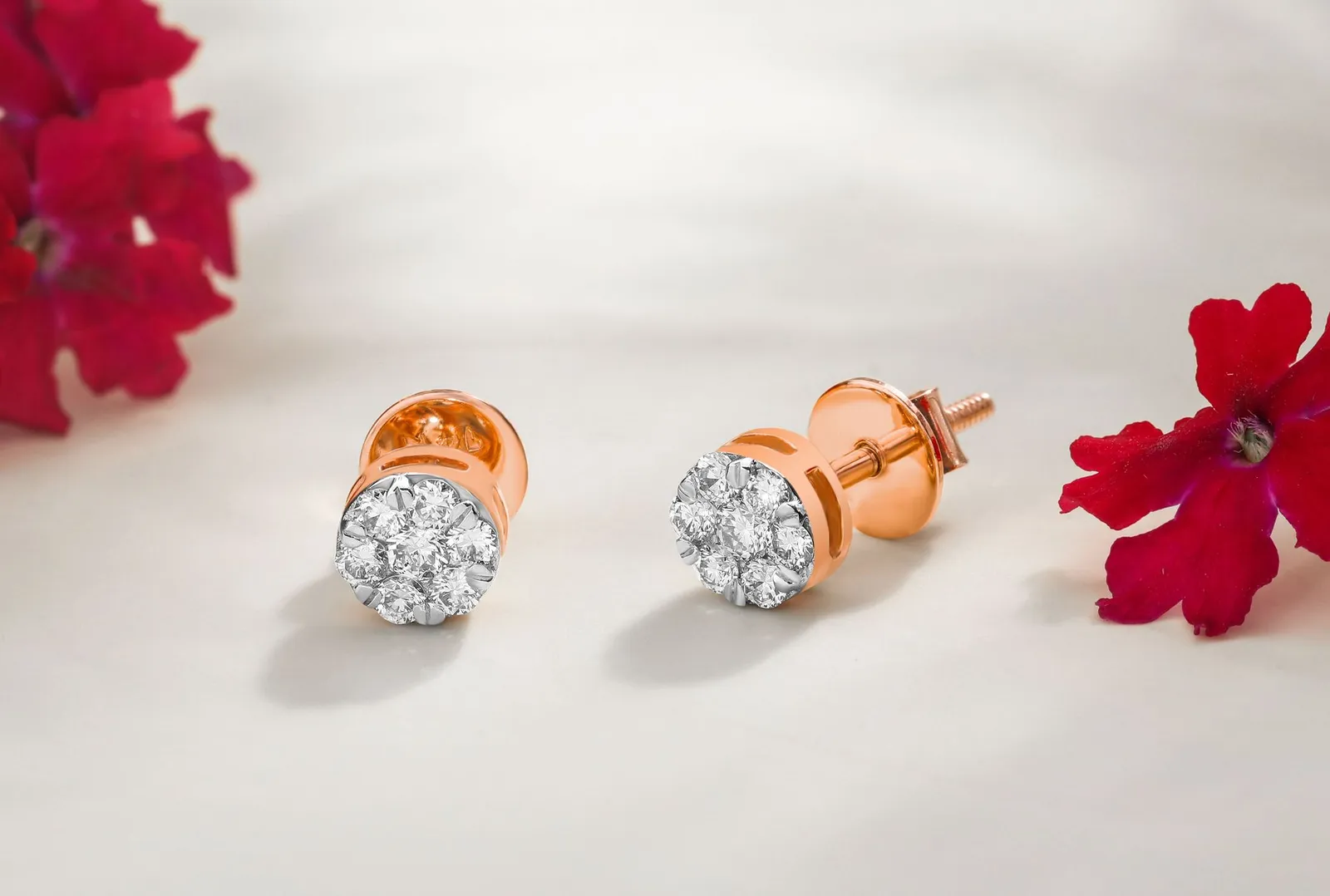
Earrings sit closer to the face than any other jewelry, so even a very small pair changes the whole look. They are also the easiest pieces to lose and the most likely to irritate if the back or the metal is wrong. This guide covers four decisions: style, back, stone size and metal for sensitive ears.
Five main styles
Studs
One stone on a straight post, sitting against the lobe. The most classic style, flattering on every face, wearable at any time — and the most popular choice for men.
Halo earrings
A center stone surrounded by a ring of small stones. The halo makes the pair look noticeably larger and brighter than the same stone worn alone. It comes in soft round and crisp square versions.
Hoops
A band of metal around the lobe, from small close-fitting ones to large loose ones. Small close-fitting hoops are the second most popular choice for men, after studs.
Drop earrings
A section that hangs below the lobe and moves with the wearer. Striking and suited to special occasions; the longer the drop, the heavier the pair.
Ear cuffs
They grip the edge of the ear and need no piercing. A way to try a look before committing to another hole.
Backs: what decides whether you lose an earring
Most earrings are lost not because a stone falls out, but because the back slips off.
Push backs
A small piece of metal with two curled wings, pushed straight onto the post and held by friction.
- Strengths: quick, easy and compact.
- Keep in mind: they loosen with time. When pushing one on no longer feels snug, have it tightened or replaced.
Screw backs
The post is threaded like a tiny screw and the back twists on.
- Strengths: the most secure option for studs. They cannot slip off during exercise, sleep or changing clothes — worth having on any valuable pair.
- Keep in mind: putting them on and taking them off takes longer; the thread wears over the years and should be checked.
Hinged closures
For hoops: a small hinged post that clicks into a notch at the other end.
- Strengths: secure, seamless, with no loose back to lose.
- Keep in mind: listen for the click when closing; a loose catch needs adjusting.
Lever backs
For drop earrings: a curved hook passes through the ear and is locked by a hinged bar behind.
- Strengths: easy to put on, secure, good for earrings with some weight.
Flat backs
The back is a flat disc lying against the skin instead of a protruding post.
- Strengths: nothing pokes when you lie on your side or wear headphones — the most comfortable for continuous wear.
Stone sizes for studs
Reference sizes for round stones, based on diamond:
- 3 mm: about 0.10 carats each. Very discreet; good for a second or third piercing.
- 4 mm: about 0.25 carats each. A popular everyday size.
- 5 mm: about 0.5 carats each. Clearly visible, still refined.
- 6.5 mm: about 1 carat each. Bold, with real presence.
Two things to note when reading specifications:
- Total weight for earrings usually covers the pair. “1 carat total” studs are two stones of 0.5 carats each.
- Moissanite is best chosen by millimeter size, because at the same size it weighs less than diamond.
The full conversion chart is in Carat and millimeters: a gemstone size chart by shape.
Matching size to the lobe
- Small, thin lobes: 3 to 5 mm. A stone that is too large and heavy tends to tip forward.
- Thick, larger lobes: 5 to 6.5 mm for balance.
- If the pair tends to droop: choose a wider back to support the stone, or a low setting that sits close to the ear.
Settings and shapes
- Three-prong setting: the stone sits low and close to the ear, showing the most stone.
- Four-prong setting: classic and secure, good for both round and square cuts.
- Bezel setting: a rim of metal around the stone. It does not catch on hair or towels — the most durable for continuous wear.
- Halo: an added ring of small stones around the center.
On shape, round is the brightest choice; the square princess cut feels more modern and assertive. How each setting works is explained in Gemstone settings.
Earrings for men
- One side or both is purely a style choice. For a single earring, go up one size for balance.
- Typical sizes: 4 to 6 mm for studs; small close-fitting hoops.
- White gold looks sharp and cool and pairs well with a steel watch; yellow gold adds warm contrast and shows the material.
- Screw backs are well worth having if you wear them during sport.
What sensitive ears need
Itching, redness or weeping after wearing earrings is mostly a reaction to nickel — a metal found in many cheap alloys and in some white gold recipes.
- Choose 14K gold or higher. The higher the karat, the smaller the share of alloying metals.
- Ask about the white gold alloy if you have reacted before: palladium white gold is kinder than nickel white gold.
- The post and the back must be gold too. The part that passes through the ear is the part in closest contact.
- Keep the posts clean. Oil, soap and cosmetics on the post also irritate, even with good metal.
New piercings
Earlobes usually take about 6 to 8 weeks to heal; cartilage takes 6 to 12 months. During that time, keep the original earrings in and follow the piercer’s instructions. Switch to a new pair once the piercing has fully healed.
Wearing and keeping them
- Put them on over a flat surface with a cloth on it, not over the sink. A small stud down the drain is gone.
- Take them off before a salon hair wash, pulling a top over your head, swimming and sleeping — unless they have flat backs.
- Check the backs periodically. A loose push back, worn screw thread or a hinge that no longer clicks should all be adjusted.
- Clean them weekly if you wear them every day: the post and the underside of the stone collect the most residue. The routine is in Caring for gold jewelry set with gemstones.
- Store them as a pair, with the backs on the posts so nothing goes missing.
Four questions to ask when choosing earrings
- What kind of back is it, and what are the post and back made of?
- Are the gemstone specifications for one stone or for the pair?
- What is the gemstone, and what is its size in millimeters?
- If one earring or a back is lost, can it be remade?
At T Gold
T Gold offers stud and halo earrings crafted in 10K, 14K and 18K gold with Moissanite, Lab Diamond and natural diamond; the karat, gemstone type and specifications are stated for every piece. See the designs in the earrings category, or contact T Gold to change the stone size or gold color, or to have a pair made your own way.