Gemstones
Moissanite, Lab Diamond or natural diamond?
All three shine brilliantly, but they differ in nature, in how they handle light, in certification and in value over time. A full comparison to help you choose.
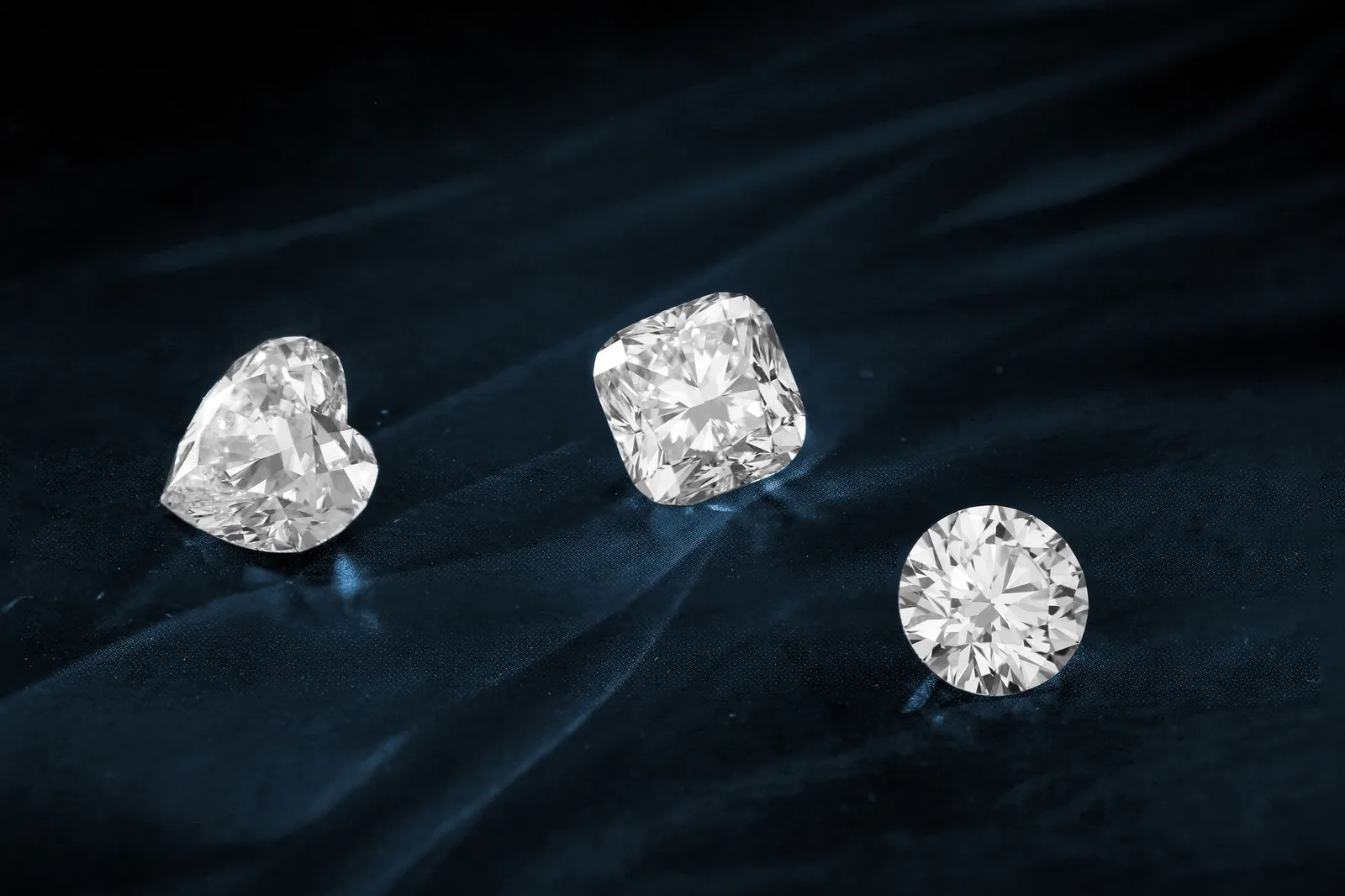
To the naked eye, a Moissanite, a Lab Diamond and a natural diamond of the same size are all white, clear and intensely bright. The differences lie in what the surface does not show: the material itself, how the stone handles light, where it comes from, the paperwork that accompanies it and how its value behaves over time. This guide walks through each point so your choice rests on facts.
Three gemstones, three natures
Moissanite
Moissanite is crystalline silicon carbide (SiC). The mineral was found in 1893 by the chemist Henri Moissan in rock samples from the Canyon Diablo meteorite crater in Arizona; he first took it for diamond and only identified it correctly in 1904. Natural moissanite is so rare that it is practically unusable for jewelry, so all Moissanite on the market is grown in a laboratory, and has been sold commercially since the late 1990s.
Moissanite is not a diamond, and not an “artificial diamond” either. It is a gemstone in its own right, with optical properties of its own.
Lab Diamond
A Lab Diamond is a real diamond: pure carbon crystallized in the same structure as a natural diamond, with the same hardness, refractive index and dispersion. The only difference is where it formed. There are two growth methods:
- HPHT (high pressure, high temperature): a press recreates the conditions deep in the earth.
- CVD (chemical vapor deposition): carbon from a gas settles layer by layer onto a diamond seed.
The process takes weeks rather than billions of years. In 2018 the US Federal Trade Commission removed the word “natural” from the definition of diamond in its Jewelry Guides, while requiring sellers to disclose laboratory-grown origin clearly.
Natural diamond
Natural diamonds crystallized some 150–200 km below the surface, most of them one to more than three billion years ago, and were carried upward by volcanic eruptions. Each one is a finite geological specimen — that rarity is the foundation of a natural diamond’s value.
The specifications compared
Hardness (Mohs scale)
- Moissanite: 9.25
- Lab Diamond: 10
- Natural diamond: 10
All three are harder than sapphire and ruby (9), hard enough for daily wear without scratching easily. Keep in mind that hardness is resistance to scratching, not to impact: a diamond can still chip at an edge if struck hard in the wrong direction, so the setting style and how it protects the stone always matter.
Refractive index — brightness
- Moissanite: 2.65–2.69
- Diamond (lab and natural): 2.42
The higher the refractive index, the more strongly a stone bends and returns light. Moissanite’s is higher than diamond’s, which makes it very bright.
Dispersion — “fire”
- Moissanite: 0.104
- Diamond: 0.044
Dispersion is the ability to split white light into rainbow colors. Moissanite’s dispersion is more than twice that of diamond, producing more flashes of color — most visible in sunlight or under spotlights.
Refraction
Diamond is singly refractive; Moissanite is doubly refractive. Under a 10× loupe, looking through a Moissanite, the facet edges at the back appear doubled. It is one of the signs specialists use to tell the two apart.
Density
- Moissanite: about 3.21 g/cm³
- Diamond: 3.52 g/cm³
Moissanite is roughly 9% lighter than diamond at the same size. That is why Moissanite is usually sold by its size in millimeters, with a “diamond-equivalent carat” alongside. A 6.5 mm round is equivalent to a 1-carat diamond, but that Moissanite actually weighs only about 0.9 carats.
What the eye sees
Specifications only matter once they turn into something visible.
- Moissanite reads as “fiery”: more flashes of color, constant sparkle as the hand moves. On designs paved with small stones the effect multiplies into an intensely bright surface — the reason Moissanite is so popular in iced-out styles.
- Diamond, lab or natural, returns more white light, with crisper contrast between bright and dark. The two kinds of diamond cannot be told apart by eye, even by professionals; it takes laboratory equipment.
- In large stones — from about 1 carat upward — the difference between Moissanite and diamond is easier for an experienced eye to spot. In densely set small stones, it all but disappears.
The certificates that come with them
- Natural diamond: usually accompanied by a GIA or IGI report with full 4Cs grading (carat weight, color, clarity, cut).
- Lab Diamond: most commonly an IGI report, graded on the 4Cs scale and stating that the diamond is laboratory-grown, the growth method and the laser inscription on the girdle. GIA, since October 1, 2025, no longer uses the natural-diamond color and clarity scales for Lab Diamonds and instead describes them as “Premium” or “Standard”.
- Moissanite: usually comes with a card or specification report, commonly GRA, describing size, weight, color and clarity on a scale borrowed from diamonds. Moissanite has no single international grading standard comparable to GIA’s 4Cs for diamonds, so this document is best read as confirmation of the gemstone type and its specifications, not as the equivalent of a diamond grading report.
A section-by-section walkthrough is in How to read a gemstone certificate.
Price and value over time
This part deserves a straight answer.
- Moissanite costs the least of the three, allowing dense settings, large stones and bold forms on a sensible budget. The value of the piece then lies mainly in its gold and craftsmanship.
- Lab Diamond costs far less than a natural diamond of the same specifications, and prices have fallen sharply in recent years as production capacity has grown. According to analyst Paul Zimnisky, in the first quarter of 2025 in the US a 1-carat round Lab Diamond averaged about USD 845, against about USD 3,895 for a comparable natural stone.
- Natural diamond is the most expensive and the only one of the three with an established resale market — although resale prices are still usually below purchase prices and depend heavily on specifications and certification.
In short: Moissanite and Lab Diamond are choices to wear and enjoy; natural diamond adds the element of rarity. In all three cases, the gold in the piece keeps a material value of its own.
Telling them apart
- Older diamond testers measure only thermal conductivity. Moissanite conducts heat almost as well as diamond, so these testers can wrongly read it as diamond.
- Multi-testers also measure electrical conductivity: Moissanite conducts electricity, while most diamonds do not. This is the quick, common check.
- A 10× loupe reveals Moissanite’s doubled facet edges and lets you read the laser inscription on the girdle.
- Lab Diamond versus natural diamond can only be separated with specialized laboratory equipment. For these two, the grading report and the girdle inscription are your evidence.
Do they change with wear?
All three gemstones are color-stable and do not cloud by themselves over time. What dulls a stone is almost always a film on its surface: skin oils, lotion, soap.
Moissanite occasionally develops a rainbow-like film on its facets from oil residue and minerals in water. It sits on the surface and cleans off; the stone is unharmed.
General care: soak in warm water with a few drops of dish soap, brush gently with a soft brush underneath the stone, rinse and dry. Avoid bleach, pool chlorine and hard knocks. Have the prongs checked periodically, especially on pieces set with many stones.
Which one to choose?
- For dense coverage, large stones, intense sparkle and a budget focused on form and gold weight: Moissanite.
- For a real diamond with clear specifications on a grading report and more size for the budget: Lab Diamond.
- For the rarity of nature, for a defining milestone or a piece meant to be kept for the long term: natural diamond.
Combinations work too: a diamond center stone with Moissanite or Lab Diamond accents — as long as each type is clearly stated.
Frequently asked questions
Is Moissanite a fake stone?
No. Moissanite is a laboratory-grown gemstone with its own name, composition and specifications. It only becomes “fake” when it is sold as diamond. What matters most is that the gemstone type is stated correctly in the documents that come with the piece.
Is a Lab Diamond a real diamond?
Yes. Chemically, physically and optically, a Lab Diamond matches a natural diamond. The difference is origin — and origin must always be disclosed.
Does Moissanite turn yellow over time?
Today’s colorless Moissanite is color-stable. Early generations had a slight yellow or green tint from the day they were made, which is where the old impression comes from.
At T Gold
T Gold works with all three: Moissanite, Lab Diamond and natural diamond. The gemstone type and specifications are stated for every piece, with certification according to the gemstone. Many designs can be made with a different gemstone on request, or built from scratch around your idea through Custom.
If you are still deciding, book a consultation to see the three gemstones side by side under the same light — the clearest comparison there is.